


Page 84 - Senior Link Magazine Summer 2026 - Online Magazine
P. 84
Local
                                                                                       History

             The Sound That


             Moved the


             South Plains Forward


               by Molly Ramirez


                                             His sense of purpose defined        selections from Tchaikovsky’s
                                             what came next. In 1946, Lubbock    Nutcracker Suite.
                                             was growing quickly. As the city
                                             expanded in population and began    In October 1946, the orchestra gave
                                             forming a unique identity, civic    its first official performance to an
                                             leaders recognized a gap: access to   audience of 1,500. The response was
                                             the performing arts. The idea of a   immediate. The Avalanche Journal
                                             symphony orchestra in Lubbock       published a review with the quote,
                                             began as a conversation among       “We are amazed at the result of only
                                             community leaders and quickly       a few months’ rehearsal.”
                                             gained traction among musicians,    The “Lubbock Little Symphony”
                                             educators, and arts advocates.
                                                                                 even had a national impact. Arthur
                                             The first symphony organizing       Fiedler, conductor of the Boston
                                             meeting took place not in a concert   Pops, took the Lubbock Symphony
                                             hall, but in a minister’s study at   tradition of performing “The Star-
                                             First United Methodist Church—      Spangled Banner” before each
                                             an intimate beginning for what      concert back to Boston after guest
                                             would eventually become one of the   conducting in Lubbock. Lubbock
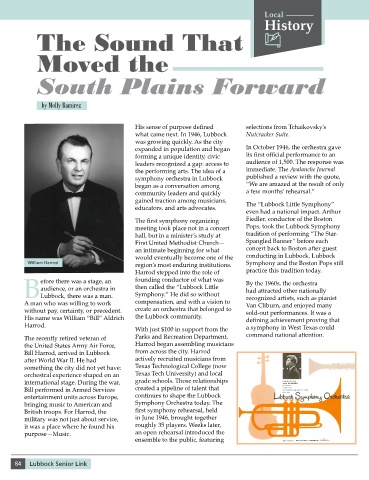
          William Harrod                     region’s most enduring institutions.   Symphony and the Boston Pops still
                                             Harrod stepped into the role of     practice this tradition today.
              efore there was a stage, an    founding conductor of what was      By the 1960s, the orchestra
              audience, or an orchestra in   then called the “Lubbock Little     had attracted other nationally
         BLubbock, there was a man.          Symphony.” He did so without        recognized artists, such as pianist
         A man who was willing to work       compensation, and with a vision to   Van Cliburn, and enjoyed many
         without pay, certainty, or precedent.   create an orchestra that belonged to   sold-out performances. It was a
         His name was William “Bill” Aldrich   the Lubbock community.            defining achievement proving that
         Harrod.                                                                 a symphony in West Texas could
                                             With just $100 in support from the
         The recently retired veteran of     Parks and Recreation Department,    command national attention.
         the United States Army Air Force,   Harrod began assembling musicians
         Bill Harrod, arrived in Lubbock     from across the city. Harrod
         after World War II. He had          actively recruited musicians from
         something the city did not yet have:   Texas Technological College (now
         orchestral experience shaped on an   Texas Tech University) and local
         international stage. During the war,   grade schools. Those relationships
         Bill performed in Armed Services    created a pipeline of talent that
         entertainment units across Europe,   continues to shape the Lubbock
         bringing music to American and      Symphony Orchestra today. The
         British troops. For Harrod, the     first symphony rehearsal, held
         military was not just about service,   in June 1946, brought together
         it was a place where he found his   roughly 35 players. Weeks later,
         purpose—Music.                      an open rehearsal introduced the
                                             ensemble to the public, featuring


      84   Lubbock Senior Link

